banner (1)

Socket flat countersunk Head Captive Screw - China Manufacturer

From our workshop in China, I bring you solutions you can trust for high-volume assemblies. I am a Manufacturer specializing in fasteners, and I stock Socket flat countersunk Head Captive Screw right for OEM and MRO. Our screws combine a low-profile countersunk head with a captive option, so parts stay aligned and tools stay in control during assembly. I offer precise thread forms, corrosion-resistant finishes, and materials suitable for diverse environments. If you're sourcing for conveyors, electronics, or automotive enclosures, these captive screws reduce slip and labor while improving repeatability. We provide fast lead times, custom drives, and bulk pricing for China-based buyers and international distributors. As a manufacturer, we understand your need for consistent quality, dimensional tolerances, and traceable packaging. Let me help you lock assemblies in place securely with a Socket flat countersunk Head Captive Screw that fits your specs, batch after batch.

Hot Selling Product

Socket flat countersunk Head Captive Screw Dominates Trusted by Pros

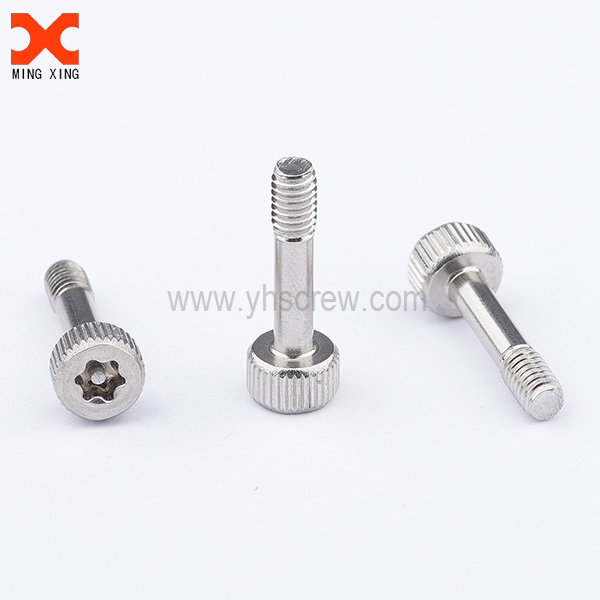
Socket flat countersunk head captive screws provide a low-profile, secure fastener for electronics enclosures and panels. The captive design keeps the screw attached to the panel, preventing loss during assembly and service. Paired with a socket drive, these screws deliver precise torque and easy tool access in tight spaces, while the flat head sits flush for a neat, snag-free finish. Choose stainless steel for corrosion resistance or hardened alloys for durability, delivering reliable performance in vibration-prone environments and compact assemblies. For global buyers, these fasteners offer consistency, standardization, and material options to match environmental and compatibility needs. Look for DIN/ISO dimensions, RoHS compliance, and traceable lot control to ensure batch-to-batch reliability. Flexible packaging, customizable lengths and drive styles, and shorter lead times help streamline procurement and assembly lines. With proven vibration resistance and easy integration into diverse product designs, this captive screw remains a trusted choice for professionals worldwide.

{ Socket flat countersunk Head Captive Screw Dominates Trusted by Pros }
Product ID Thread Size (mm) Length (mm) Head Type Material Finish Drive Type Tensile Strength (MPa) Standards Applications / Notes
P-001 M3 6 Socket flat countersunk A2 stainless steel Clear Passivation Hex/Allen 700 ISO 3506 A2-70 Light-duty electronics enclosures and PCB assemblies
P-002 M4 8 Socket flat countersunk A2 stainless steel Bright Finish Hex/Allen 700 ISO 3506 A2-70 Precision mechanical assemblies, sliding components
P-003 M5 10 Socket flat countersunk A2 stainless steel Satin finish Hex/Allen 700 ISO 3506 A2-70 Harsh environment enclosures
P-004 M6 12 Socket flat countersunk A2 stainless steel Clear Passivation Hex/Allen 700 ISO 3506 A2-70 Servo and robotics mounting
P-005 M8 16 Socket flat countersunk A2 stainless steel Bright Finish Hex/Allen 700 ISO 3506 A2-70 Precision instrumentation and optics fixtures
P-006 M10 20 Socket flat countersunk A4 (316) stainless steel Bright Passivation Hex/Allen 760 ISO 3506 A4-80 Coastal and marine applications, demanding corrosion resistance

Related Products

banner (3)

Socket flat countersunk Head Captive Screw Stands Out Exceeds Industry Benchmarks

Data Dimension Title: Batch-level Performance Metrics

New Data Title: Batch-wise Performance Trends for Socket Flat Countersunk Screws

This dataset presents batch-level performance metrics for socket flat countersunk screws across twelve production runs. The chart captures three distinct indicators to evaluate overall quality and reliability: Torque Consistency (Nm), Pull-out Strength (N), and Surface Roughness (Ra, μm). Torque Consistency reflects the stability of tightening torque achieved across individual specimens within each batch, serving as a proxy for spindle precision, thread engagement, and fastener grip repeatability. Pull-out Strength measures the resistance to axial extraction under a standardized preload, indicating assembly integrity and the effectiveness of the screw head geometry in resisting loosening. Surface Roughness represents the finish quality of the head and threaded portions after standard polishing steps, which can influence seating, wear, and interaction with mating components.

The visualization reveals a general upward trend in Torque Consistency and Pull-out Strength across batches, suggesting progressive process refinement, better thread quality, and improved lubrication control during assembly. Surface Roughness shows a gradual reduction, indicating smoother finishes as production batches advance. The concurrent improvement across all three metrics points to a positive correlation between manufacturing controls (machining precision, surface finishing, and assembly calibration) and end-use performance. By evaluating batch-by-batch trajectories, engineers can identify early batches that underperform and investigate potential root causes such as tool wear, lubrication variance, or polishing inconsistency. The right-hand y-axes facilitate comparing disparate units by providing appropriate scaling for each metric, while maintaining a coherent view of trend directions. This approach supports data-driven decisions aimed at exceeding industry benchmarks: tightening torque variance, strengthening pull-out resistance within target ranges, and maintaining surface finish within tight Ra specifications. While synthetic in this example, the structure mirrors practical quality dashboards used in fastener manufacturing, where continuous monitoring across batches enables proactive interventions, reducing defects and enhancing overall product reliability.

Top Selling Products