
A small fastener can become an unexpected leakage point in an EV battery enclosure. When a battery enclosure uses a plastic or composite cover, the screw needs to do more than hold two parts together. The fastening point also needs to help prevent moisture from entering the enclosure.
This is why simply purchasing a product labeled “sealing screws” or “waterproof screw” may not solve the problem. Reliable sealing depends on the screw, O-ring, plastic boss, mating surface, and installation conditions working together.

Why Can Water Leak Around a Screw?
A standard screw provides clamping force, but it does not automatically seal the fastener entry point. Moisture can potentially travel through gaps beneath the screw head or around the fastening interface.
An O-ring sealing screw addresses this problem by placing an elastomer seal beneath the screw head. When the screw is tightened correctly, the O-ring compresses against the mating surface and creates a sealing barrier around the entry point.
However, adding an O-ring alone does not guarantee waterproof performance. The groove dimensions, O-ring material, compression, mating surface, and tightening torque all affect sealing reliability.
Plastic Enclosures Need the Right Thread Design
For plastic or composite battery enclosures, engineers also need to consider how the screw engages with the housing.
A machine screw normally requires a pre-threaded hole or metal insert. A thread-forming screw for plastic can create a mating thread directly inside a properly designed plastic boss, which may eliminate the need for an additional insert in some assemblies.
The pilot hole is especially important. If the pilot hole is too small, installation torque increases and excessive stress may crack the plastic boss. If the hole is too large, thread engagement decreases and the screw may strip or loosen.
Buyers should therefore provide the fastener manufacturer with the plastic material, boss dimensions, pilot-hole size, required clamp load, and expected number of assembly cycles rather than selecting the screw by diameter alone.
How Should You Choose the O-Ring Material?
Different O-ring materials suit different operating environments.
NBR is commonly used where resistance to oils and many hydraulic fluids is required. EPDM performs well with water and outdoor weather exposure but is generally unsuitable for mineral oils. Silicone is useful for applications with wider temperature variations. FKM is often selected for higher temperatures or more demanding chemical environments.
For an EV battery enclosure project, buyers should tell the supplier the expected temperature range and whether the sealing point may contact water, oils, chemicals, or cleaning agents.
Simply specifying a “rubber O-ring” does not provide enough information for reliable material selection.
More Torque Does Not Mean Better Sealing
Overtightening is another common mistake.
Too little O-ring compression may leave a leakage path, but excessive compression can damage the O-ring, force it out of the sealing groove, or place unnecessary stress on the plastic enclosure.
The correct installation torque needs to provide enough clamp load while maintaining suitable O-ring compression.
For this reason, the screw head, sealing groove, O-ring cross-section, plastic boss, and mating surface should be evaluated as one fastening system.
What Should Buyers Provide for a Custom Sealing Screw?
Instead of sending an RFQ that only says “M6 waterproof screw,” buyers can receive a more accurate solution by providing:
-
2D or 3D drawings
-
Plastic or composite material
-
Boss and pilot-hole dimensions
-
Thread requirements
-
Sealing method
-
Operating temperature
-
Water or chemical exposure
-
Corrosion requirements
-
Assembly and service conditions
These details help the manufacturer determine whether the application is better suited to a machine screw, thread-forming screw, O-ring sealing screw, or another custom sealing structure.
Custom Sealing Fasteners for EV Enclosures
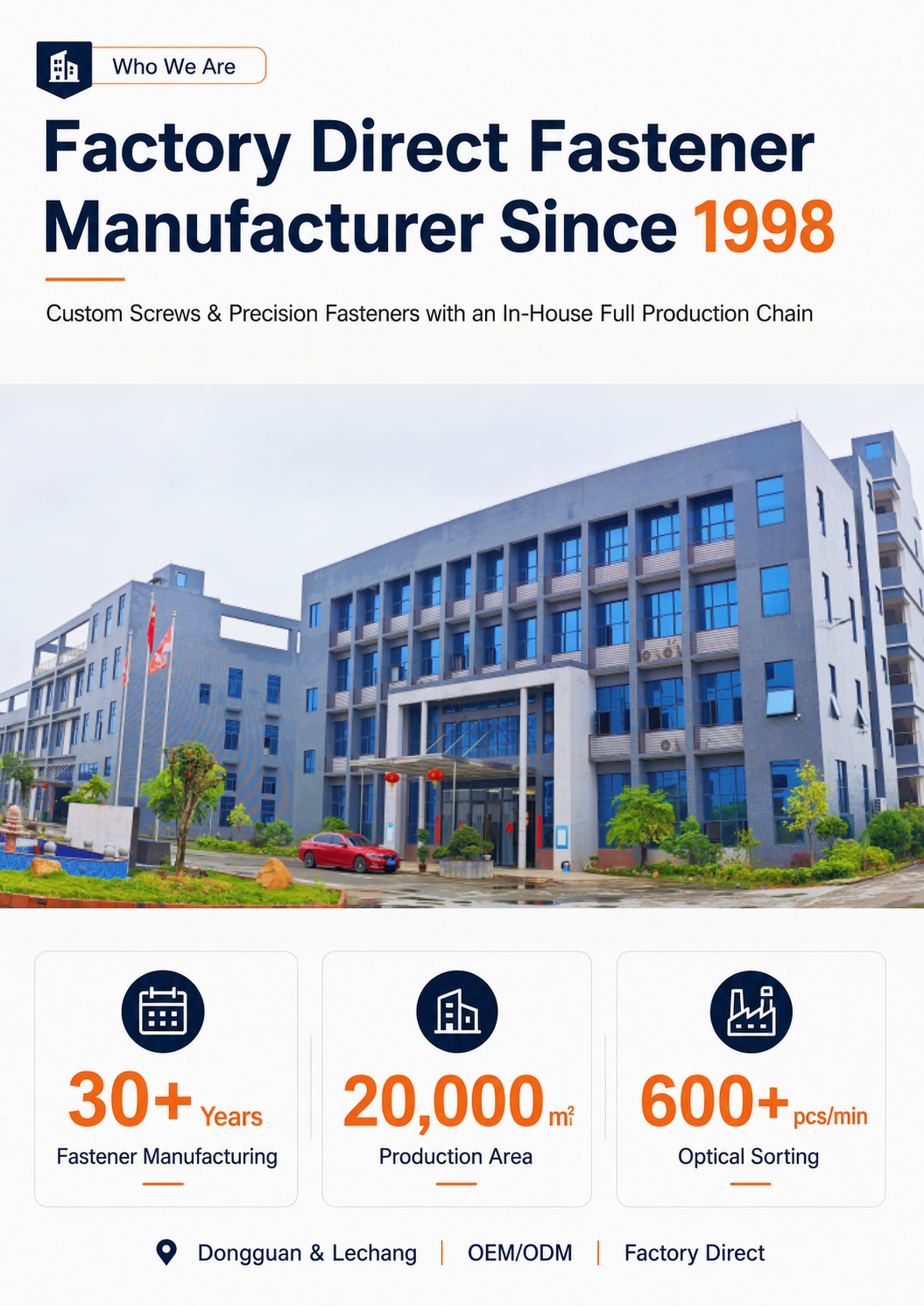
Yu-huang Electronics Dongguan Co., Ltd. has manufactured custom fasteners since 1998. We support drawing- and sample-based customization of thread profiles, dimensions, materials, surface treatments, O-ring options, sealing structures, and anti-loosening functions.
For EV battery enclosures, outdoor electrical housings, automotive electronic modules, and other moisture-sensitive assemblies, our engineering team can review the mating structure and provide DFM suggestions before sample production.
Send us your drawing, enclosure material, sealing requirements, and operating conditions to discuss a custom fastening solution.
Yuhuang
A4 building, Zhenxing science and Technology Park, frist in dustrial area
tutang village, changping Town, Dongguan City, Guangdong
Post time: Sep-04-2026





