banner (1)

ball spring plunger - Exporter for Precision Machinery Components

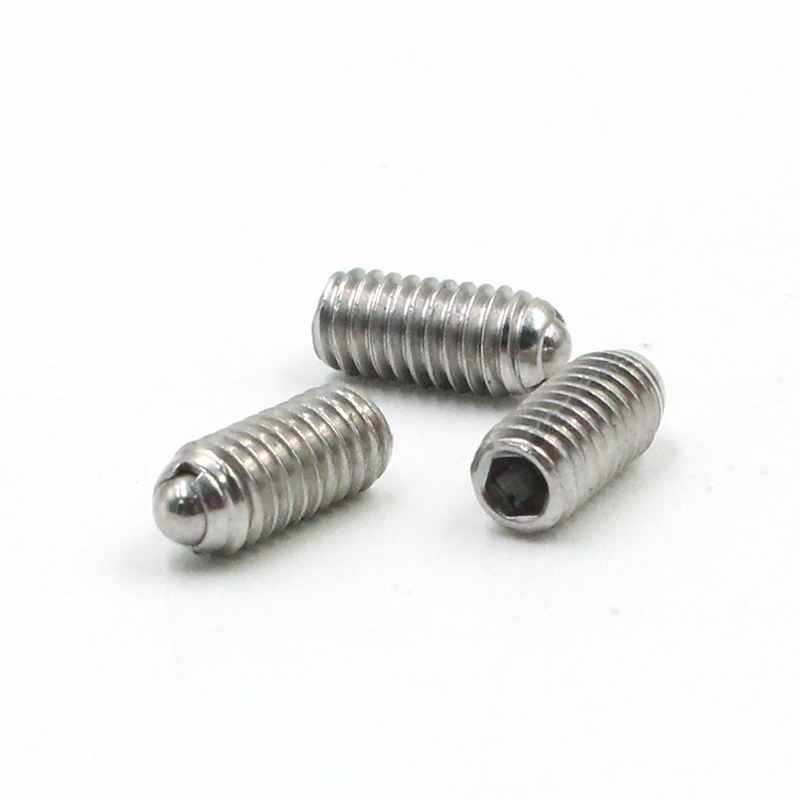
We offer high-precision ball spring plungers designed for repeatable locating and indexing in automated fixtures. As an experienced supplier, I ensure every unit delivers consistent preload, smooth action, and long life under vibration and impact. Made from stainless steel with hardened springs, our ball spring plunger resists corrosion and maintains accurate detent positions across temperature ranges. Available in many thread sizes and ball diameters to fit your fixture, CNC, or mold tool. Order online or contact us for custom coatings or seals. Buy with confidence from a reliable Exporter who understands industrial demands. Whether you’re assembling automation lines or maintaining jigs, these plungers deliver fast setup and reliable performance in busy production. We stand behind our products with clear datasheets, prompt lead times, and support for OEMs and distributors. Let's discuss your exact spec and I’ll tailor the right ball spring plunger for your application.

Hot Selling Product

ball spring plunger Products Guarantees Peak Performance

Ball spring plungers are compact, high-precision components used to locate, index, and hold parts in fixtures and automation lines. To guarantee peak performance, select designs with precise machining, durable materials, and corrosion-resistant finishes. Options include stainless steel bodies, hardened pins, and tailored preload, stroke, and seating depth to suit your application. Built to withstand vibration, impact, and temperature changes, they deliver repeatable seating force with minimal backlash for smooth, reliable cycles. Global buyers benefit from strong quality controls and traceability at every stage, plus testing that mimics real-world use. Custom features fit both metric and imperial interfaces, with flexible lead times and scalable MOQs. Compliance with ISO 9001 and RoHS is standard, and packaging and logistics are optimized to protect parts in transit. Whether for automotive, electronics, or automation equipment, these plungers promise consistent performance, easy integration, and dependable supply.

{ ball spring plunger Products Guarantees Peak Performance }
Product ID Material Body Ø (mm) Ball Ø (mm) Thread Size Stroke (mm) Load Rating (N) Operating Temp (°C) Surface Finish Tolerance IP Rating Mounting Type Certification Country of Origin Warranty (yrs) Application Notes
PBP-001 Stainless Steel 304 6 3 M4 2 40 -20 to 100 Passivated ±0.05 IP40 Through-hole ISO 9001 China 2 Linear actuator, precision assembly High-precision deflection for automation
PBP-002 Stainless Steel 304 8 3 M4 3 60 -20 to 120 Electro-polished ±0.05 IP54 Through-hole RoHS USA 5 High-load fixtures Suitable for demanding automation environments
PBP-003 Stainless Steel 316 10 4 M5 4 80 -40 to 130 Passivated ±0.04 IP54 Blind ISO 9001 Germany 3 Medical device assembly Salt spray resistant
PBP-004 Alloy Steel 6 3 M3 2 30 -10 to 90 Black Oxide ±0.08 IP40 Through-hole ISO 9001 Japan 2 General automation Budget-friendly option
PBP-005 Brass (CuZn15) 12 5 M6 5 70 -20 to 110 Electro-polished ±0.05 IP54 Through-hole RoHS China 2 Packaging machinery High corrosion resistance at contact points
PBP-006 Stainless Steel 316 8 4 M4 4 50 -30 to 110 Passivated ±0.04 IP54 Blind ISO 9001 USA 3 Robotics grippers Deep threaded variants available
PBP-007 Stainless Steel 304 10 3 M4 2 20 -15 to 85 Electro-polished ±0.05 IP40 Through-hole RoHS Germany 5 High-speed indexing devices Low-stiffness spring for speed
PBP-008 Alloy Steel 6 2 M3 2 25 -20 to 80 Black Oxide ±0.06 IP40 Through-hole ISO 9001 China 1 General-purpose Economy grade

Related Products

banner (3)

ball spring plunger Industry Giant Your End-to-End Solution

Monthly Production Volume Trend

This chart visualizes the Monthly Production Volume Trend for a hypothetical manufacturing segment. The data dimension is time (monthly intervals) and the measure is production volume (in thousands of units). Data covers January through December, with values gradually increasing from January to December. The line chart provides a compact view of how production responds to seasonal demand, capacity changes, and operational adjustments across the year. The gridlines improve readability of exact levels, while the axis labels help identify when peaks occur. The chosen color and point markers emphasize the trajectory and individual observations without clutter. Methodology: Data points were defined for each month and plotted on a standard Cartesian coordinate system. The y-scale is rounded to convenient increments to reduce visual noise, and margins were added to avoid clipping of labels. A simple linear interpolation connects consecutive points to reveal trends. Outliers or anomalies would require additional notes or alternate visualization (e.g., moving averages or confidence bands). The current dataset assumes consistent measurement units and excludes season-specific distortions beyond what is represented in the numbers. Interpretation: The chart indicates a general upward trend throughout the year, suggesting improving throughput or rising demand. The steepest gains occur in the second half of the year, consistent with ramp-up initiatives or late-year orders. The relatively smooth trajectory implies stable operations, whereas any real-world deployment should verify whether minor dips correspond to maintenance windows or supply interruptions. Stakeholders can use this visualization to compare actual performance against quarterly targets, identify months with under- or over-performance, and plan resource allocation accordingly. Potential enhancements include adding a moving average line to smooth short-term fluctuations, annotating notable events (new equipment, holidays), or exporting the data for deeper statistical analysis. The current chart is a static summary and does not capture underlying variability or forecast uncertainty, so it should be paired with domain context and additional metrics for robust decision-making.

Top Selling Products