
](https://cdn.globalso.com/customizedfasteners/page_banner041.jpg)
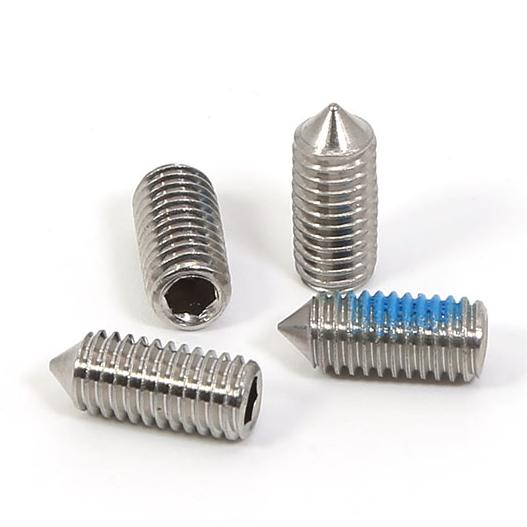
Set screws (also named grub screws) serve core positioning and shaft‑locking purposes across mechanical transmission, automation equipment and instrument hardware. Field engineers frequently encounter unexpected failures such as slipping, loosening, shaft surface damage or screw fracture. Most troubles do not stem from raw‑material defects, but wrong tip‑style selection, wrong torque setting or substrate mismatch when applying set screws.
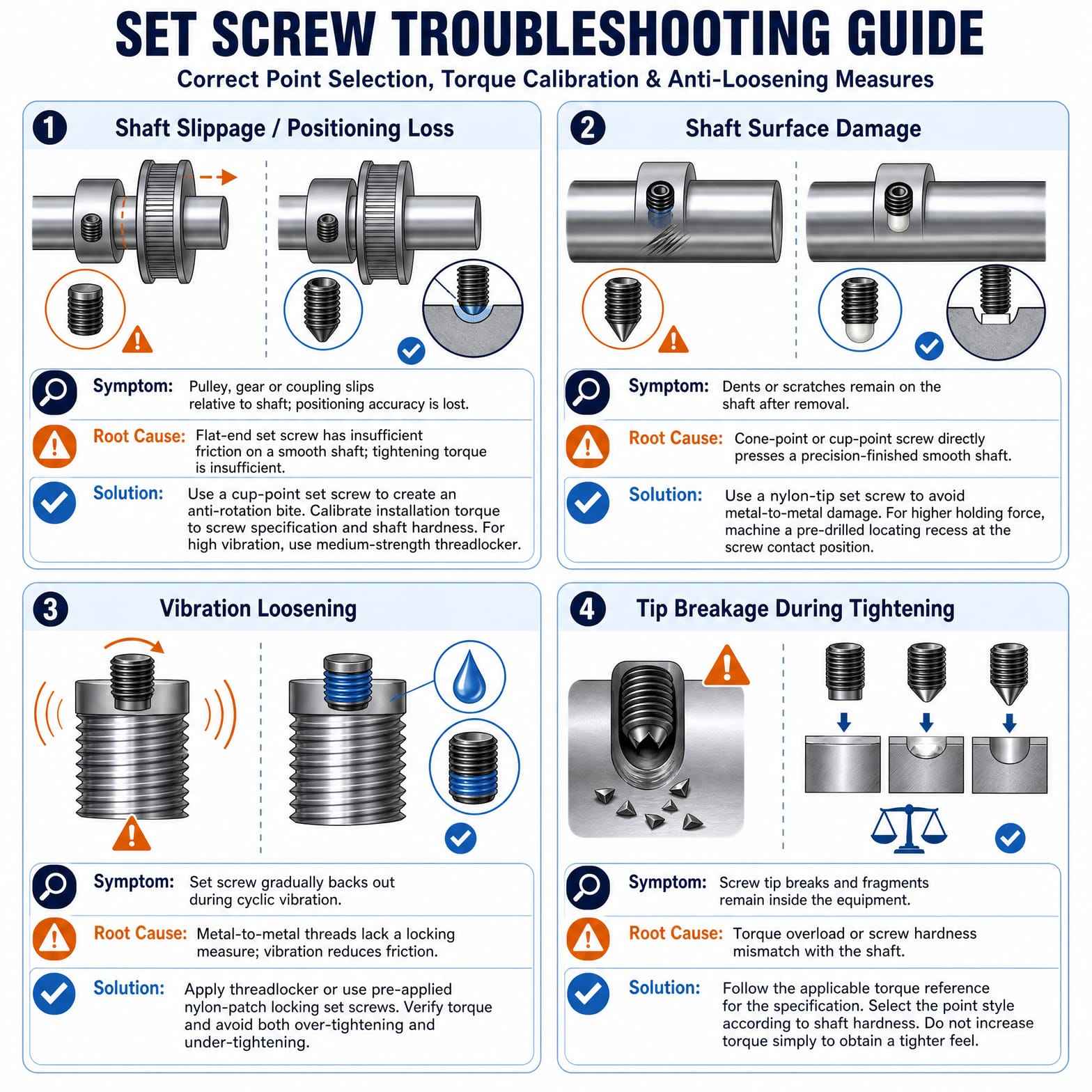
Failure 1: Screw slips, shaft rotates out of position
Phenomenon: After short running‑in, the fastened pulley, gear or coupling slips relative to the shaft, losing positioning accuracy.
Root‑cause:
- Wrong point‑type selection: flat‑point set screws cannot provide enough anti‑slip friction on smooth shaft surface under vibration load.
- Insufficient tightening torque.
Practical fix: Switch to cup‑point set screws; its concave tip creates micro‑indentation on shaft surface for anti‑rotation interlock. Calibrate installation torque according to screw size and shaft hardness. For high‑vibration scenarios, add medium‑strength thread locker.
Failure 2: Shaft surface gets severely crushed / gouged
Phenomenon: After disassembly, obvious pits and scratches appear on shaft outer circle; shaft reuse precision drops sharply.
Root‑cause: Cone‑point or cup‑point set screws are used on high‑precision finished shafts without pre‑machined positioning dimples. Hard screw tip presses directly onto smooth shaft surface.
Practical fix: For finished‑surface precision shafts without positioning pits, pick soft‑tip nylon‑pad set screws to avoid metal‑on‑metal crushing damage. If high locking force is required, machine small positioning dimples on shaft at corresponding set‑screw position.
Failure 3: Set screws back‑out spontaneously under continuous vibration
Phenomenon: Equipment running with cyclic vibration; set screws gradually loosen and back out, causing positioning failure.
Root‑cause: Pure metal‑to‑metal thread fit lacks locking measure; cyclic vibration destroys static friction between threads.
Practical fix: Adopt thread locker compound; or choose nylon‑pre‑coated anti‑loosening set screws. Re‑check torque value, avoid both over‑tightening and under‑tightening.
Failure 4: Set‑screw tip shears off during installation
Phenomenon: Screw tip breaks while tightening; broken fragment stays inside assembly cavity, difficult to remove.
Root‑cause: Excessive over‑torque; or using dog‑point / cone‑point set screws onto shafts with material hardness far lower than screw hardness.
Practical fix: Follow torque reference value matching screw dimension. Select corresponding tip geometry for different shaft hardness. Do not apply maximum torque blindly for better locking feeling.
Pre‑order verification checklist for set screws
Before confirming bulk order for set screws, go through these four checks:
- Confirm working objective: pure positioning, anti‑rotation locking, or anti‑axial‑displacement, select tip style accordingly (cup / flat / dog / nylon tip).
- Evaluate shaft surface requirement: allow indentation, or must keep original smooth finish.
- Judge working‑condition vibration level, decide whether anti‑loosening treatment is required.
- Test assembly performance on real shaft sample before mass‑production deployment.
Final summary
Set screws are simple‑looking tiny fasteners, yet tip geometry, torque setting and shaft‑material matching directly decide whole‑equipment reliability. Project teams should define application requirements clearly at design phase, instead of picking general‑purpose set screws only by thread size. Communicate shaft‑material and operating‑condition parameters with fastener suppliers for targeted specification suggestion.
Post time: Aug-24-2026





