
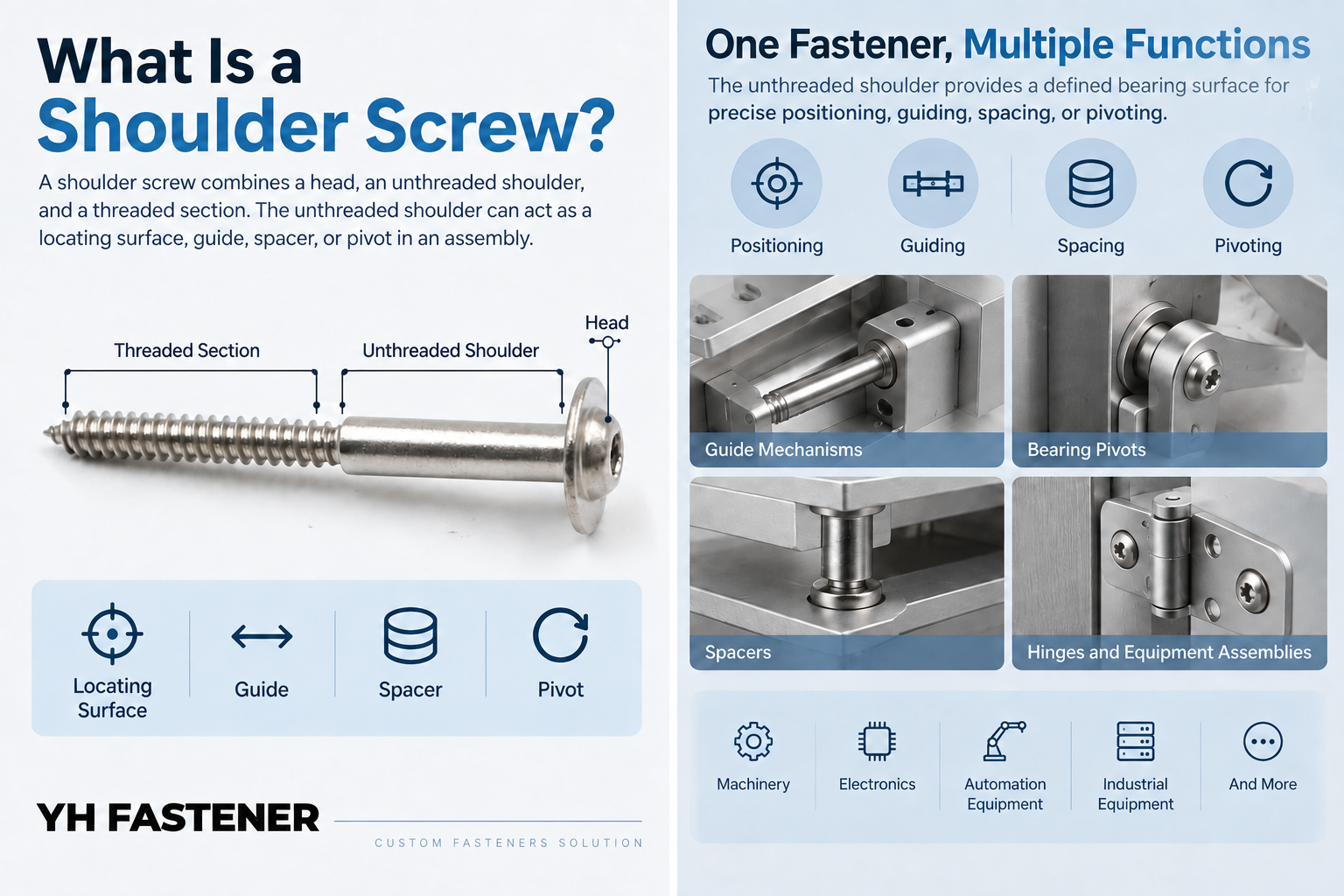
What Is a Shoulder Screw?
A shoulder screw normally combines a head, an unthreaded shoulder, and a threaded section. The shoulder provides a defined surface for a rotating, sliding, or positioned component, while the thread secures the fastener in the mating part. The shoulder length and diameter should be defined by the assembly drawing because they determine clearance, location, and the available bearing surface.
Yu-huang Electronics provides a shoulder screw product range that includes standard and custom directions. The selection should remain application-dependent: a screw used as a guide pin may require a different shoulder relationship from one used as a bearing pivot or spacer.
How Do Shoulder Diameter and Length Affect Positioning?
Shoulder diameter is directly related to the bore or component being located. The fit should allow the intended movement or positioning without creating unwanted interference. Shoulder length controls how much of the component is supported and where the threaded section begins. If the shoulder is too short, the thread may enter the moving area; if too long, the head or unsupported section may affect the assembly stack-up.
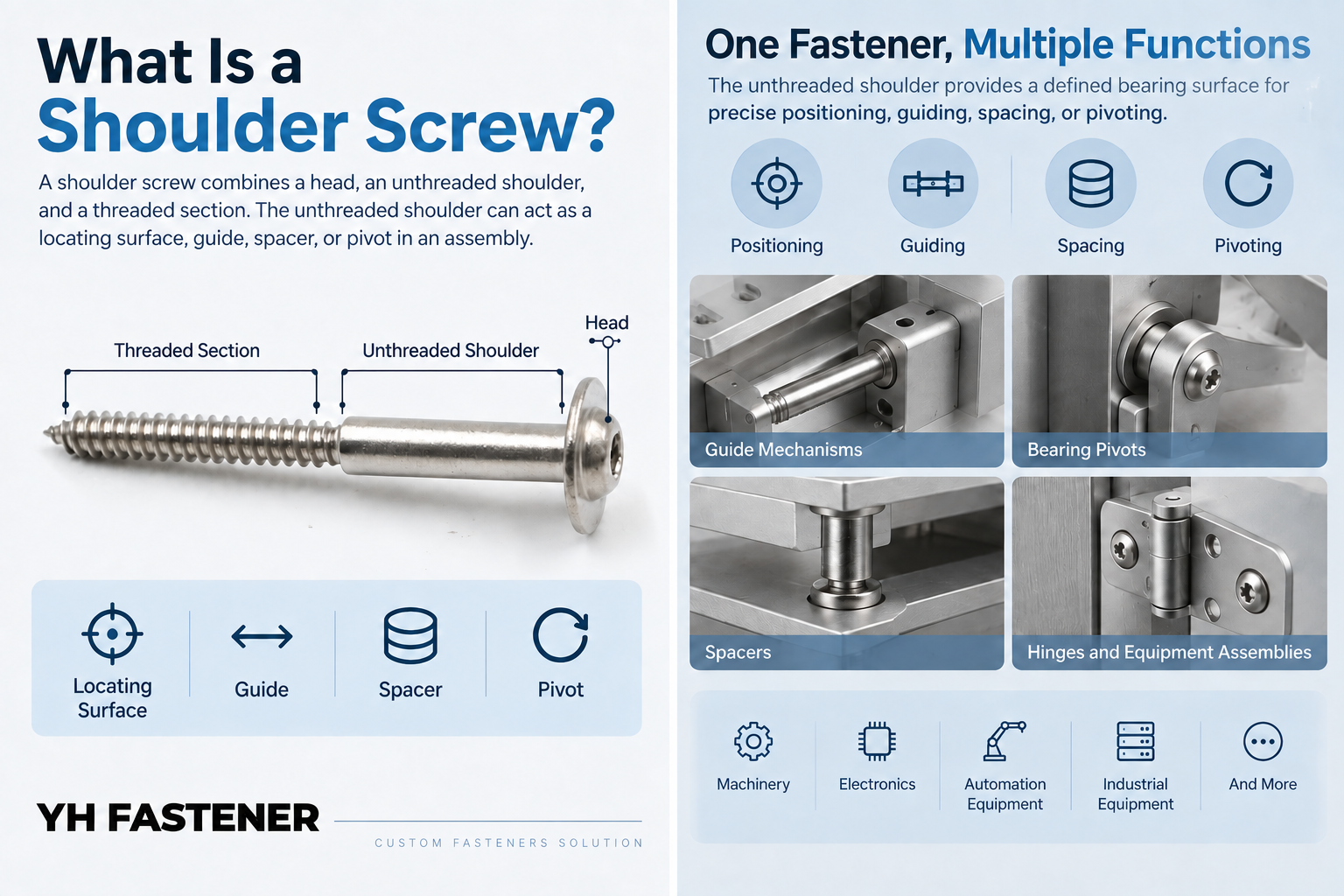
When Is a Precision Shoulder Screw Needed?
A precision shoulder screw should be considered when the shoulder functions as a repeatable locating, guiding, or bearing surface and the assembly depends on controlled relationships between the shoulder, bore, head, and thread. The required tolerance, surface condition, and inspection method must be defined by the drawing; no generic tolerance should be assumed from the product name.
Drive and head access also influence selection. A Torx head shoulder screw may be evaluated when the specified tool interface and head design suit the installation process. For a washer-head design, precision shoulder screws with a Torx washer head can be discussed as a configuration option.
How Should Materials and Features Match the Application?
Material and surface finish should be selected according to the mating components, operating environment, corrosion considerations, appearance, and assembly method. If the joint also needs a sealing feature, shoulder sealing screws with an O-ring may be reviewed, with sealing performance dependent on the interface, compression concept, material, and validation requirements.
For internal-hex installation, M5 hex socket shoulder screws illustrate a socket-drive direction. The stated size is part of that product configuration, not a universal recommendation. Engineers should confirm thread, shoulder, head, and tool-clearance requirements together.
Which Applications Use Shoulder Screws?
What Should Buyers Send to a Shoulder Screw Manufacturer?
Provide a drawing or sample showing shoulder diameter, shoulder length, thread size, total length, head style, drive, material, surface finish, mating bore, assembly direction, and any washer or sealing requirement. Also identify whether the part is used for positioning, guiding, spacing, or pivoting.
Yu-huang Electronics supports custom fasteners through OEM/ODM development, DFM review, sample confirmation, production, and quality traceability.
Yuhuang
A4 building, Zhenxing science and Technology Park, frist in dustrial area
tutang village, changping Town, Dongguan City, Guangdong
Post time: Oct-06-2026